Effective Speech
Students develop skills in speech composition, delivery, and critical listening.
Media and Communication · Penn State Behrend
A portfolio of teaching practice and student work that moves beyond the classroom.
Tiffany A. Petricini, Ph.D.Associate Teaching Professor of Communication
Explore the portfolio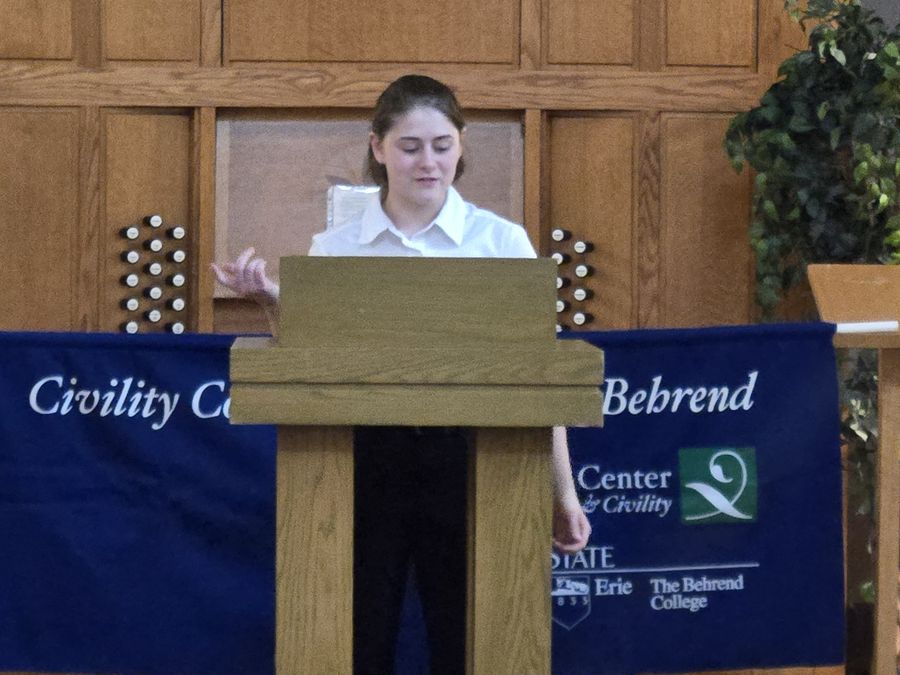 Public speakingCivil Tongue, first place · Spring 2026
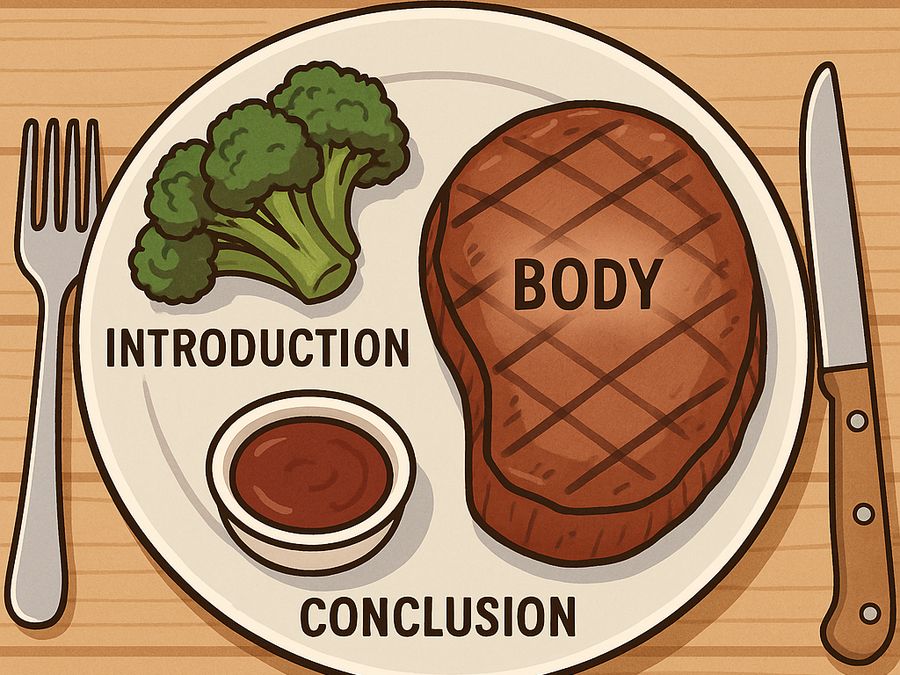
CAS 100AThe speech as a meal
 HUM 220NZines in place of notes
 AI Across BordersStudent podcasts · Fall 2025
The commitments behind the practice
I teach because I believe learning grows through relationships. Students need to feel that they belong in the classroom and that their ideas are worth exploring. I want them to leave my courses better able to communicate with others and to use what they have learned in the lives they are building.
My top priority is ensuring all students feel supported, informed by my own student experience, my professional development, and student feedback.
Key Practices
I frame student success as holistic flourishing, with key lessons I have learned from my teaching experience:
Key Practices & Insights
My courses are designed to be interactive and inclusive, using technology as a tool for connection rather than a replacement for human relationships.
Generative AI in teaching & in this portfolio
A note for reviewers about the role of generative AI in my teaching and in the making of this portfolio.
I use generative AI in my teaching in specific, bounded ways, and I say so in the classroom. I treat AI as a tool to be examined, not a shortcut to be hidden. My courses include AI literacy work: students read and discuss the current research on how AI is used and perceived in higher education, we talk through ethical-use frameworks such as the AI-Use Ethics Matrix I developed with a colleague, and I design assignments that ask students to use AI transparently and then reflect on what the tool did and did not do for them.
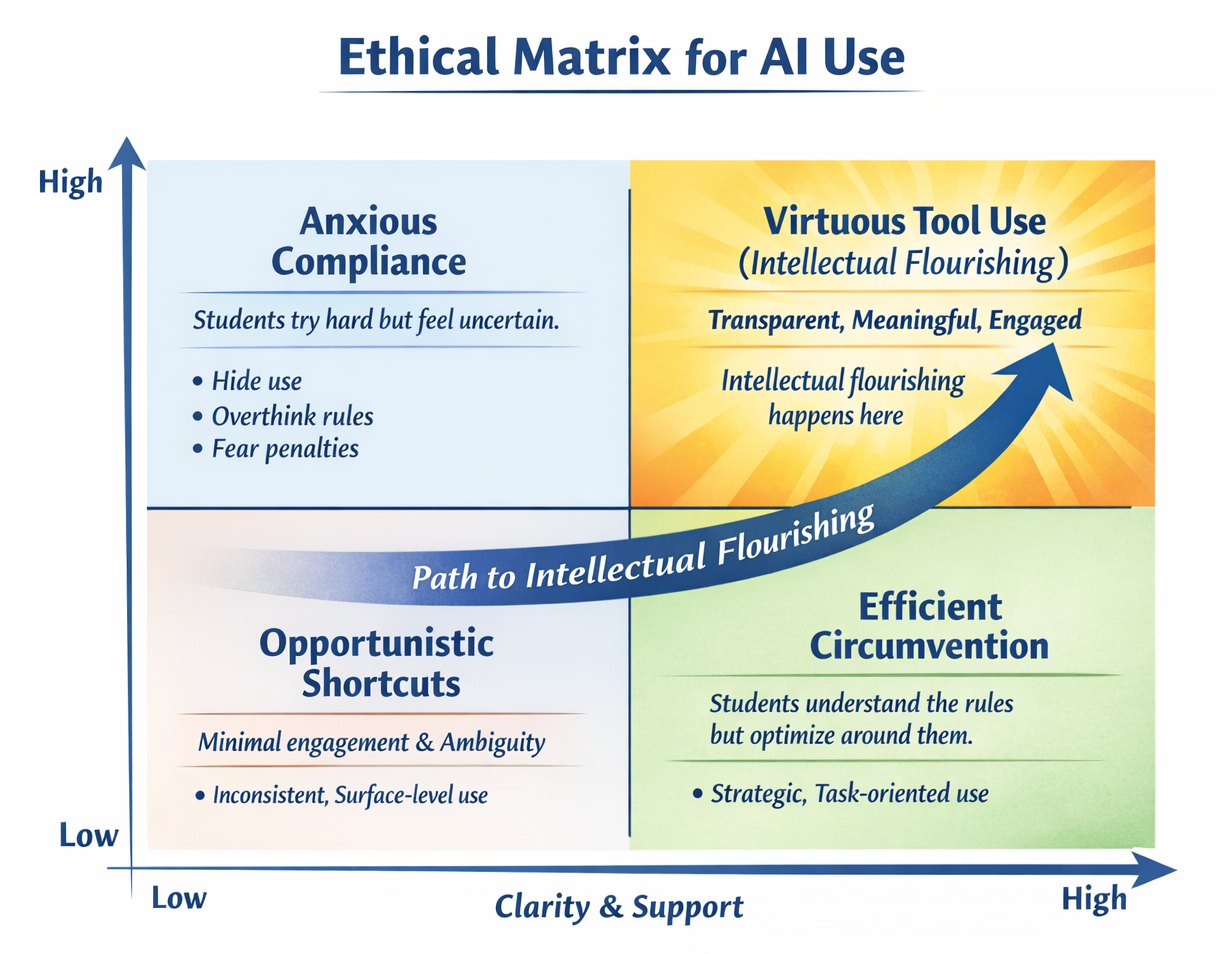
I also use generative AI to help me build this portfolio. I drafted portions of the writing here with AI assistance, and I reviewed and revised all of it myself. Where AI helped shape a sentence, it is my voice and my judgment that appear on the page. I am naming that use because reviewers deserve to know how this document came together, and because transparency about AI is part of the same practice I ask of my students. The portfolio's claims about my teaching rest on the evidence cited in each chapter: the course materials and the student work. AI helped me organize and state those claims; it did not generate the underlying evidence.
Curriculum & learning environments
Course overviews and current syllabi, collected in one place.
CAS 100A and HUM 220N anchor my recent teaching. The linked Google Docs contain the Fall 2026 course requirements, goals, and readings.
I also developed and taught COMM 335N: Media, Social Justice & Public Humanities and CAS 383N: Culture and Technology during the assessment period. These new course preparations are represented here as curriculum development; neither is part of my current teaching assignment.
Students develop skills in speech composition, delivery, and critical listening.
HUM 220N: Artificial Intelligence and the Human Experience invites students to explore humanistic questions about AI, its impact on everyday life, and what it means to be human in a digitally mediated world. The course emphasizes critical analysis and creative practice together — examining how AI shapes identity, communication, and culture, and how we might shape AI in return.
This course examines the critical role of media in social justice movements and public humanities. With a hands-on digital storytelling and community engagement focus, students develop skills in critical media analysis, public communication, and collaborative projects. The course connects academic inquiry to real-world advocacy and civic life.
This course examines the complex relationship between technology and culture, equipping students to critically analyze and creatively engage with how media shapes identity, community, and society. The course is grounded in media ecology and phenomenology, and asks students to think deeply about the tools, platforms, and systems that structure everyday life.
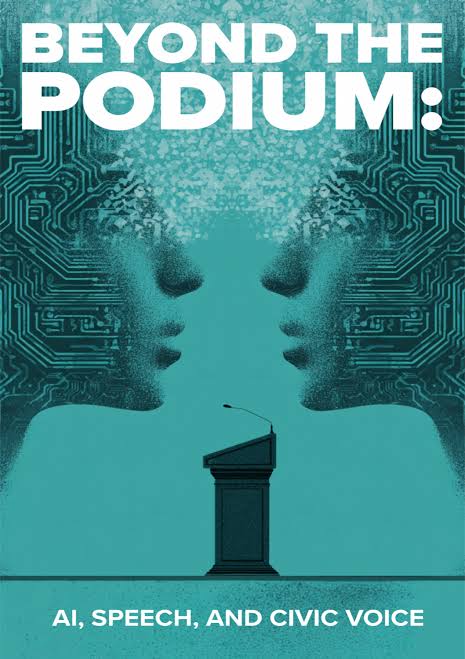
Open educational resource · Co-editor
I co-edited Beyond the Podium: AI, Speech, and Civic Voice with Sherry Rice. This freely available public-speaking textbook brings AI literacy into the communication basic course, connecting speech preparation with questions of ethics and civic participation.
My work on this resource extends my commitment to textbook affordability into curriculum development. It offers students and instructors an open resource for considering how emerging technologies shape public communication.
The syllabi open directly in Google Docs. Updates to these documents are available through the same links.
Teaching in practice
From participation to collaboration to a student-created podcast, and how I assess the work along the way.
Creative course practice · HUM 220N
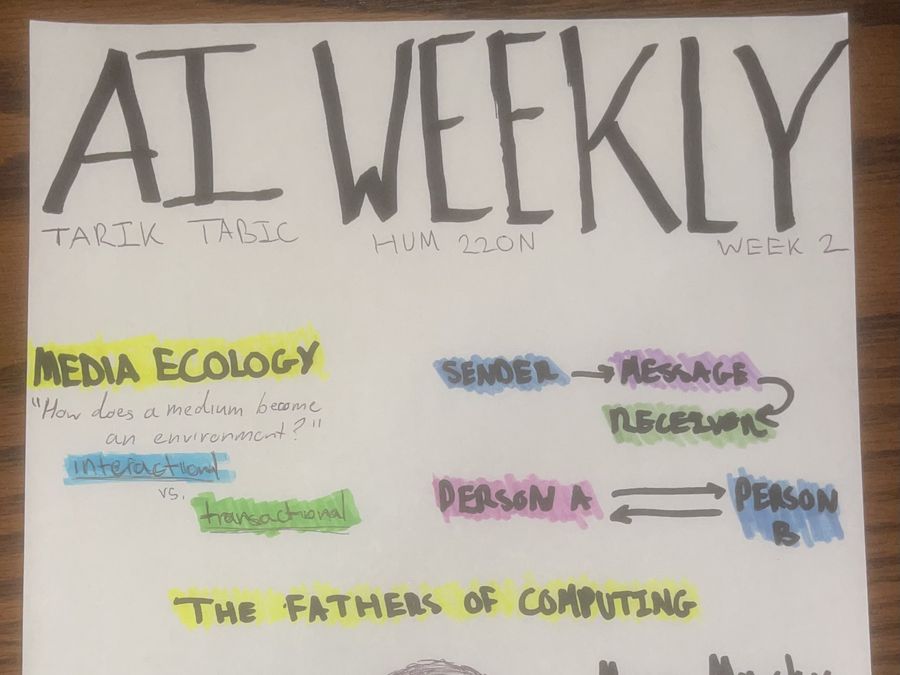
I supply materials and ask students to create zines instead of traditional handwritten or digital notes. Two examples by Tarik bring together course ideas through text, drawing, and diagrams.
See Tarik’s two zines →Selected project
The Fall 2025 EDGE project connects international collaboration, AI literacy, and student podcast production. The project overview and student podcasts below show how the exchange connected course ideas with collaborative work.
Explore AI Across Borders and the student podcasts →AI-assisted course design · HUM 220N · Fall 2026
When students struggled with the technical vocabulary of large language models, I used AI to help build a review around the concepts in my course slides. I chose a familiar Jeopardy-style format, simplified questions about course thinkers, and revised the clues to ask for one clear answer.
The result pairs a Google Doc study sheet that students copy and complete with an interactive board where every table can answer. A final comic challenge asks students to draw the journey from a prompt to the next token. AI helped generate and implement the materials; I set the learning priorities and directed the revisions. In class, students responded enthusiastically. Working in teams gave them time to discuss the concepts and learn from one another during a substantial review of the material. Their responses also helped me see where gaps remained and gave me direction for subsequent instruction. These classroom observations showed me the value of making students’ thinking visible during review.
Explore the game and the design process →I design assessment to make room for practice, application, and another attempt.
Example · HUM 220N final project
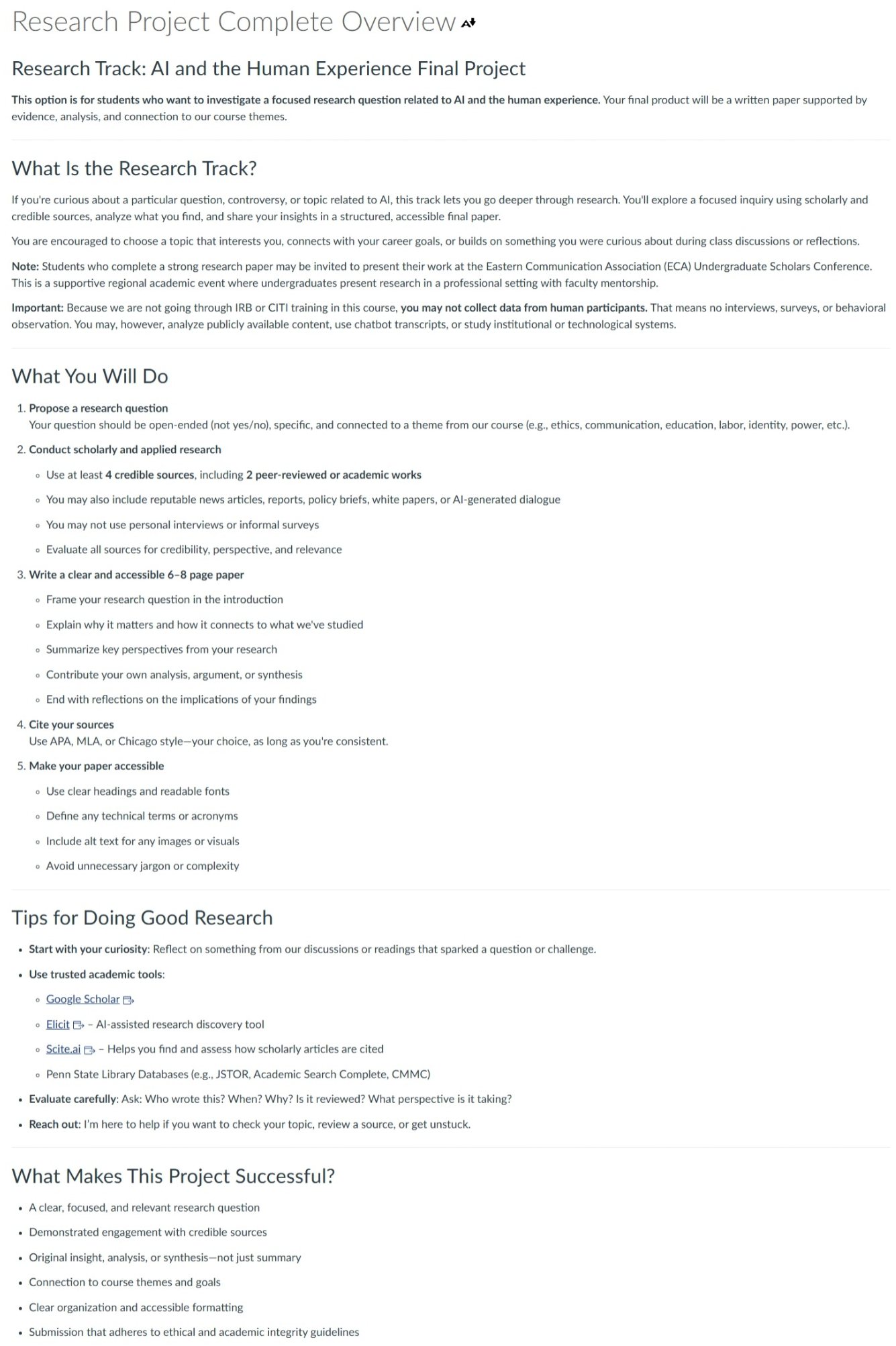
For the HUM 220N final project, students choose the form that fits their question: a research paper or a practicum project they design and build. Both tracks carry the same expectations for connection to course themes, ethical practice, and accessibility, and each one is laid out the TILT way: what the track is for, what students will do, and what makes the work successful.
Students pose an open-ended research question tied to a course theme, work with at least four credible sources (including two peer-reviewed works), and write a six- to eight-page paper that contributes their own analysis rather than summary. Because the course does not go through IRB review, students study publicly available content, chatbot transcripts, or institutional and technological systems instead of human participants. Strong papers may be invited to the Eastern Communication Association Undergraduate Scholars Conference.
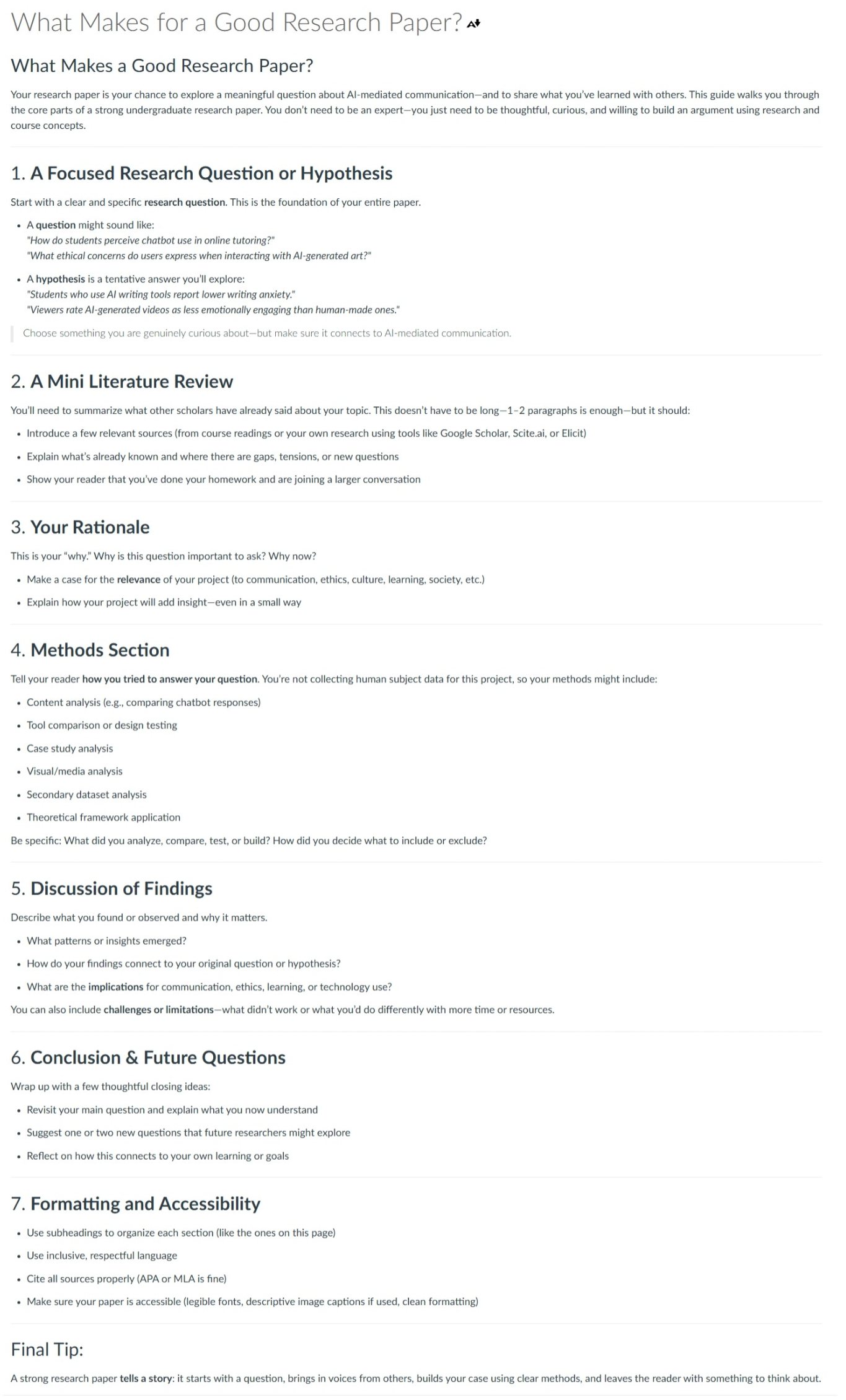
Students who would rather make something than write a traditional research paper can build a bot, a podcast episode, a zine, a data visualization, a short film, or something else they propose. The work is staged so that feedback arrives along the way: a proposal at the end of September, a documented build, a presentation in Week 14, and a two- to three-page creator’s reflection.
“Dr. Petricini is an amazing professor who truly cares about her students”
Learning through making
Student achievement · Spring 2026
My student Sophia Ginader won first place in the Civil Tongue competition in Spring 2026. Each CAS class section selects one student to compete, bringing students from across the sections together to demonstrate their public-speaking skills.
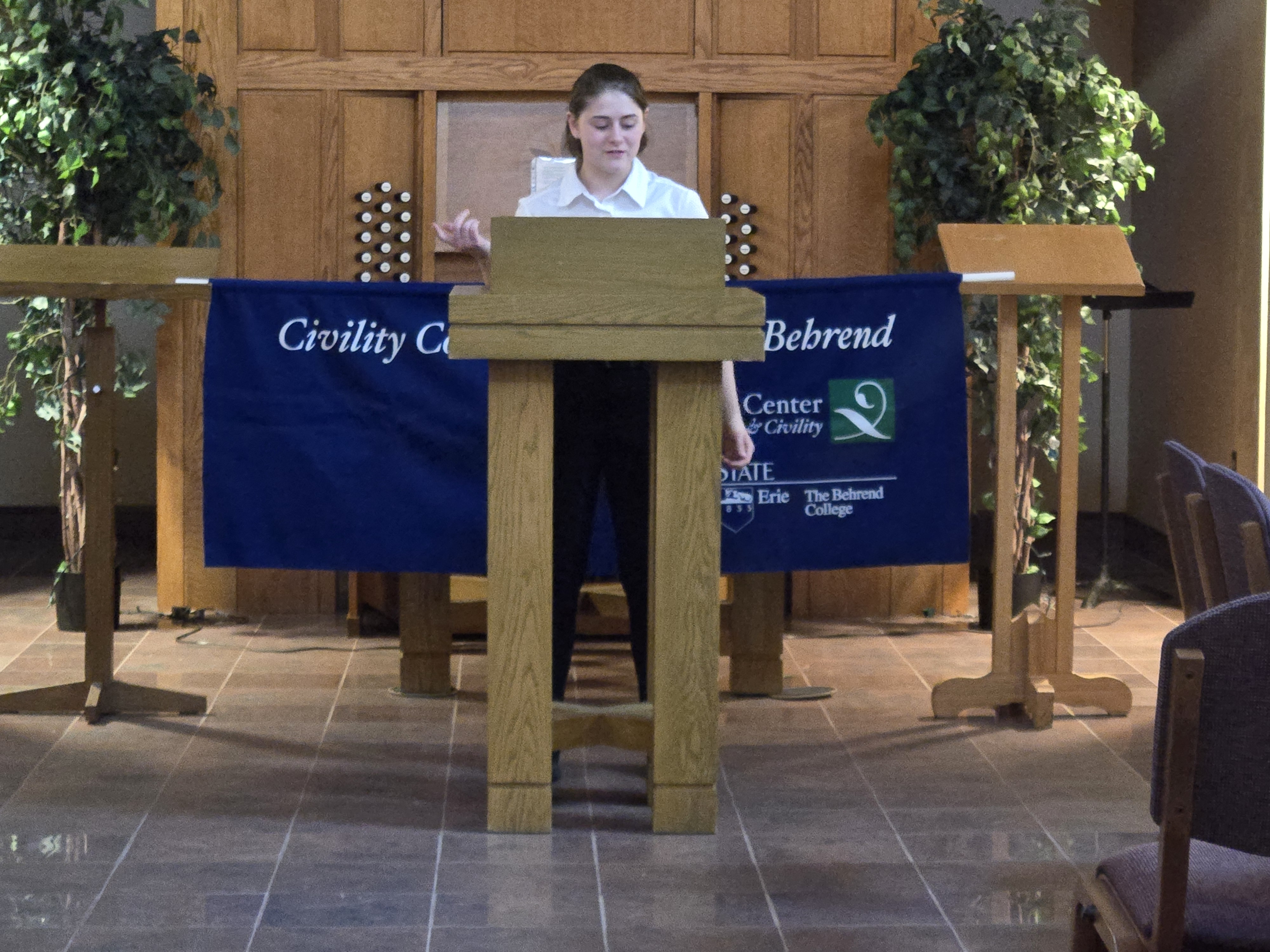
Public speaking · Student example
I selected this speech as a strong example of student public speaking. It is shared here with the student’s permission.
Watch the student speech on YouTube ↗The video starts at 0:06 when played. If the embedded player is unavailable, use the YouTube link above.
A creative alternative to traditional notes.
In HUM 220N: Artificial Intelligence and the Human Experience, I ask students to create zines in place of traditional notes, whether handwritten or digital. I supply the materials for this work.
These two examples show how Tarik brings course concepts together through handwritten text, drawings, color, and diagrams. His AI Weekly zines are shared here with his permission. The communication-model diagrams in Week 2 and the semantic network in Week 3 make relationships between ideas visible. These pages provide examples of how a student organizes course concepts; they do not, on their own, establish a change in understanding over time.
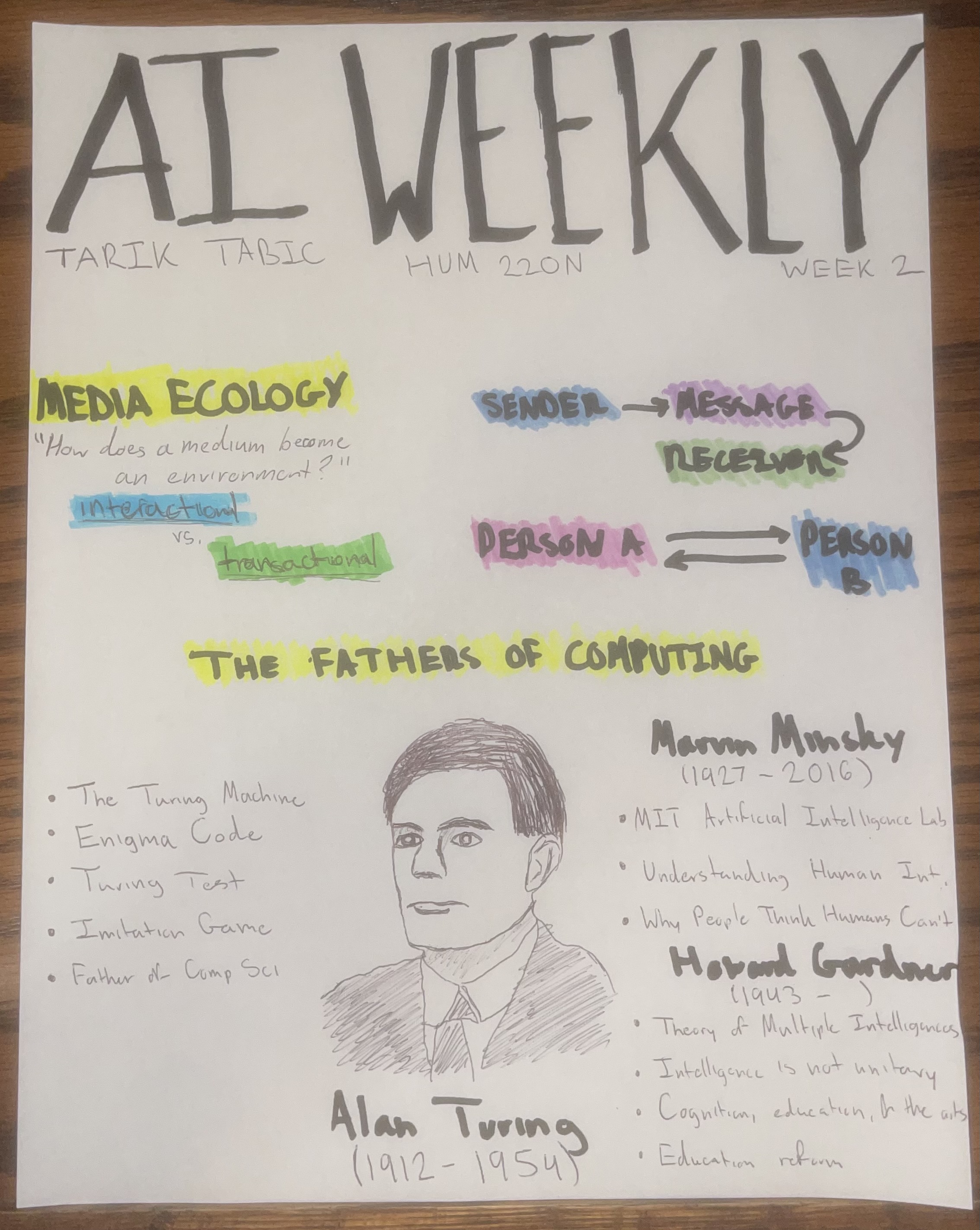
Media ecology, communication models, and the history of computing.
View Week 2 at full size ↗A handmade page titled “AI Weekly,” labeled HUM 220N, Week 2. The upper half asks, “How does a medium become an environment?” and compares interactional and transactional communication, with sender–message–receiver and person-to-person diagrams. Below, a portrait of Alan Turing accompanies notes on the Turing machine, Enigma, the Turing test, and the imitation game. Notes on Marvin Minsky and Howard Gardner appear alongside the portrait. Yellow, blue, green, and pink highlighting separates the topics.
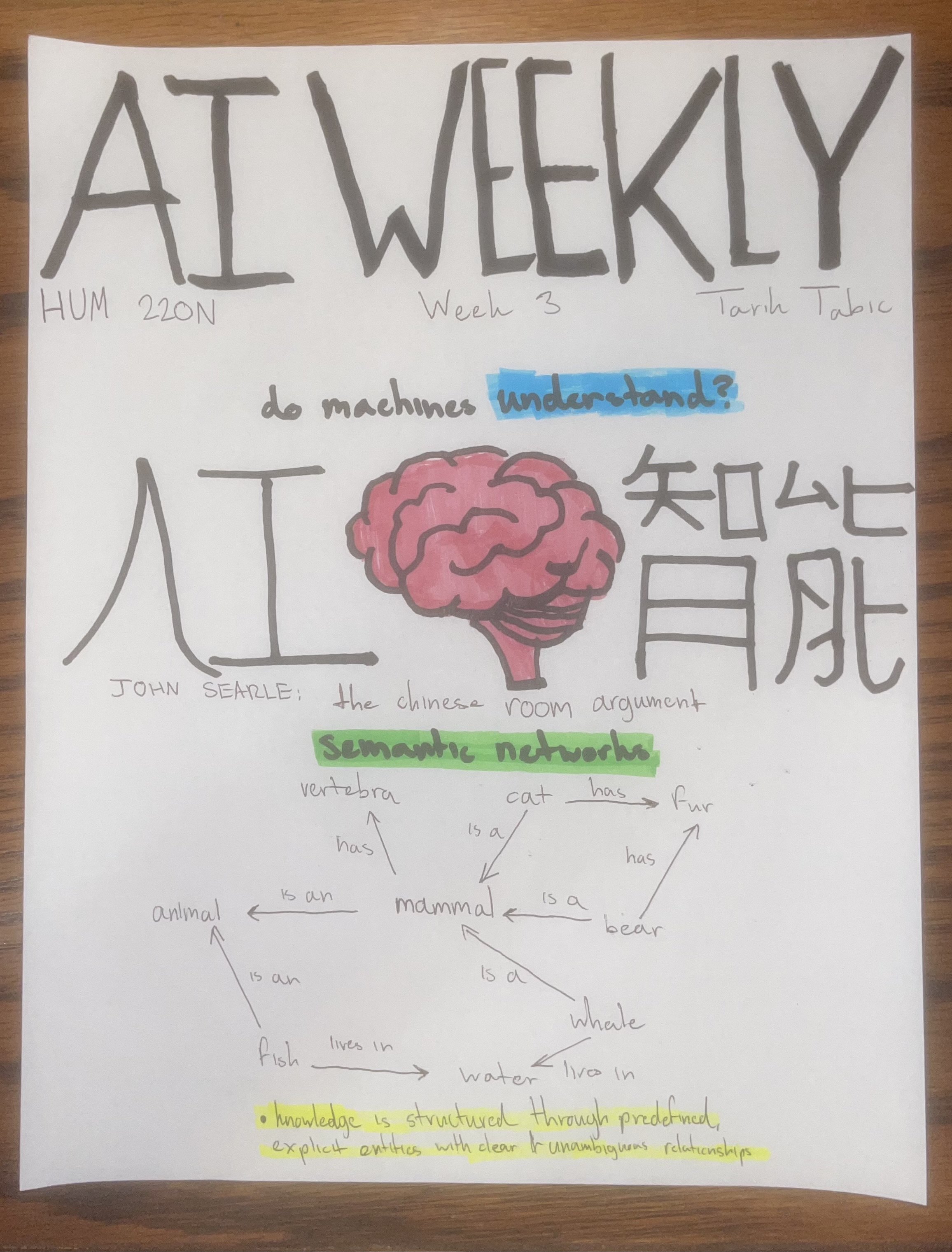
Machine understanding, the Chinese room argument, and semantic networks.
View Week 3 at full size ↗A handmade page titled “AI Weekly,” labeled HUM 220N, Week 3. The question “Do machines understand?” appears above a pink drawing of a brain, flanked by large Chinese characters. A caption names John Searle and the Chinese room argument. Under a green “Semantic networks” heading, arrows connect animals, mammals, cats, bears, whales, fish, fur, and water using relationships such as “is a,” “has,” and “lives in.” A highlighted closing statement describes knowledge structured through predefined entities and explicit relationships.
Student work by Tarik, reproduced with permission. The photographs preserve his original work.
Intercultural learning through conversation, collaboration, and student-created podcasts.
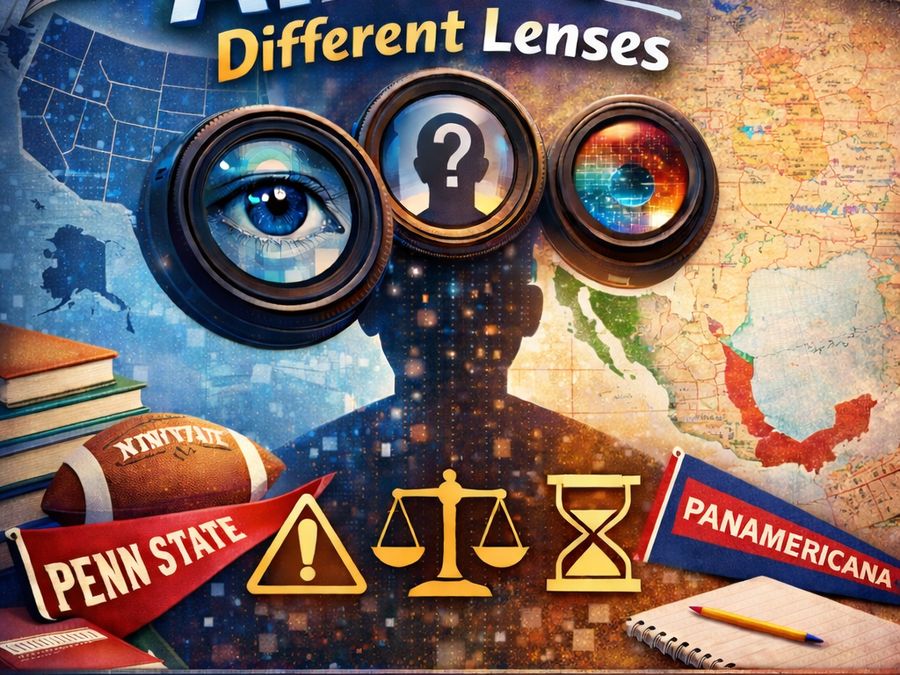
In Fall 2025, I worked with Laura Trujillo-Liñán at Universidad Panamericana in Mexico City on a six-week Collaborative Online International Learning (COIL) exchange with Penn State Behrend. Part of the EDGE initiative, the project brought students together across languages, institutions, and experiences of AI.
Students explored how AI fits into their own lives, compared perspectives with international partners, and created a shared podcast and an individual reflection. The aim was to make their assumptions visible through conversation with someone whose experience of AI might differ from their own.
Being a part of the AI Across Borders has made me think about AI in ways I hadn't before. It made me realize that AI, like people themselves, is complex.
The assignment moved through five steps: introduction and partner connection; interview and exchange; planning and organization; a final podcast, cover image, and blurb; and an individual final reflection.
Immersion asked students to notice their own experiences and assumptions about AI. Encounter brought those perspectives into dialogue with international partners. Reflection invited students to reconsider their views through comparison and collaborative work.
The exchange also informed research on intercultural AI literacy, drawing on surveys from 152 participants across the two institutions and 19 consented reflective essays from US participants. The teaching question remains central: how do students’ educational, linguistic, and cultural contexts shape the ways they understand and use AI?
Hear the collaboration: two student-produced episodes.

Featured student podcast · 10:32
Noah Gabreski, Mia & Luciano
A collaborative final episode from the AI Across Borders exchange, presented with the group’s submitted cover artwork.
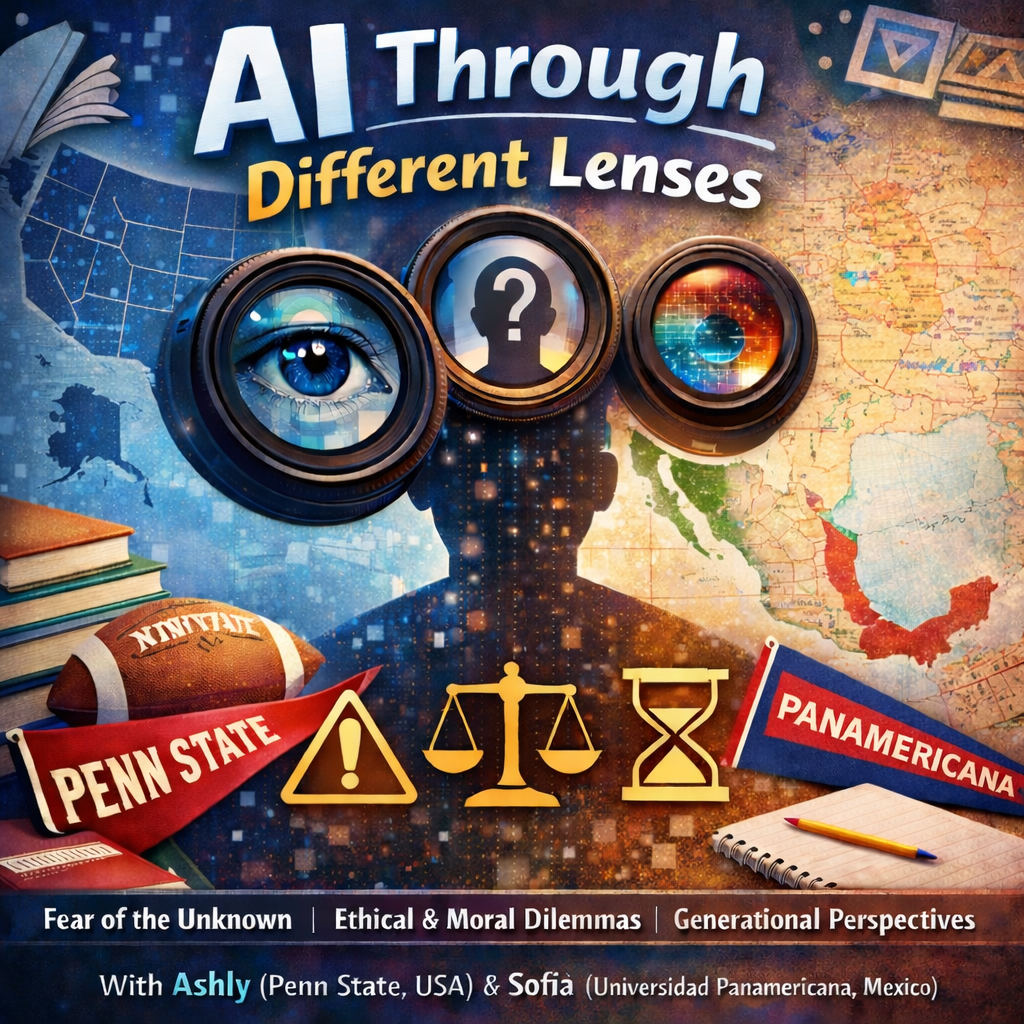
Thinking With AI · Episode 1 · 9:47
Ashly Meeker · Penn State, USA
Sofía Peña · Universidad Panamericana, Mexico
Ashly and Sofía compare how their fields, cultures, and experiences as students shape their views of AI. Their episode blurb highlights uncertainty about emerging technology, ethical concerns, and generational differences.
Captions and transcripts for these two episodes have not yet been added.
Learning through inquiry
Supporting students as they develop and pursue their own research questions.
My teaching extends to independent studies and funded undergraduate research. These projects bring questions about AI, ethics, communication, and research methods into sustained work with individual students and small teams.
Faculty reader for Brian Yearwood’s Schreyer Honors College thesis, “Applications of AI-Simulated Training in the Customer Service Industry.” The role includes reviewing the project draft before pilot testing and reviewing the final study write-up and analysis after data collection.
Independent study on Kant and AI, including Kant chatbot development.
A media ecological ethnography of a personally built AI agent.
Building models to analyze syllabus language in AI policies.
I advised three Undergraduate Student Summer Semester Research Fellowships: Hope Edwards, Teo Weaver, and Noelle Dang. Each fellowship provided $4,000 in research support.
To strengthen my support for classroom research and independent studies, I also completed the Statistical Horizons AI Data Analytics Certificate.
Continuing to learn
Certificates, fellowships, and professional learning that inform my teaching.
My professional learning supports AI literacy, research mentoring, global learning, and inclusive course design. The 2024 Global Learning fellowship provides background for the international collaboration featured in this portfolio.
I completed this certificate to strengthen my support for students working with data in class and in independent studies. This training helps me guide students toward more effective use of AI in data analysis.
Completed a semester-long course with a practicum project and certifying exam. My participation in the Center’s research group ran from September through December 2025.
Completed an intensive course in open-source language models, small-scale language model development, open-source transcription tools, and convivial technology design.
Selected as one of 40 women across the globe for a year-long program supporting exceptional and impact-minded individuals working on questions of AI in education.
Project: Generative AI in Higher Education: Innovation Unleashed for the Future of Student Experiences
Focus: Developing AI literacy objectives to embed in general education curriculum.
Selected as one of 30 faculty in the first Global Fellows cohort through Penn State Global, the Schreyer Institute for Teaching Excellence, and EPIC.
4 Continuing Education (CE) credits; 40 Pennsylvania ACT 48 credits
Completed faculty training in Writing Across the Curriculum.
These pre-July 2024 awards provide background for the continuing emphasis on student support and active, collaborative learning. They are not awards received during this assessment period.
The complete professional record
My complete record of teaching, scholarship, service, and professional learning.
My current CV is available in Google Docs.